Saturday, 25 June 2011

New mayan tomb found

Tiny camera reveals the inside of a Mayan tomb that has been sealed for 1,500 years


A tiny, remote-controlled camera has been lowered into an early Mayan tomb that has been sealed for 1,500 years.
Extraordinary footage of the tomb at the Palenque archaeological site in southern Mexico revealed an apparently intact funeral chamber with red frescoes, pottery and pieces of a funerary shroud made of jade and mother of pearl.
It also showed a series of nine figures depicted in black on a vivid, blood-red background.
Archaeologists say the images from one of the earliest ruler's tombs found at Palenque will shed new light on the early years of the once-great city state.


Friday, 24 June 2011

Canadian Strongman Lifts 22 Gals

Women on Top: Canadian Strongman Lifts 22 Gals


How did you spend the weekend?Kevin Fast

If you lifted 22 women at once weighing more than 2,000 pounds combined, congratulations -- you must be a Canadian strongman.
Ripley's Believe It or Not says Kevin Fast, one of the strongest of all the strongmen the company has ever documented, carried out the feat over the weekend at a performance in Ontario.
"I'll keep piling people on until it can't fit anymore, or I can't lift anymore!" Ripley's quoted Fast as saying in a news release before the event.
And he didn't stop there: Fast was also joined by his son, Jacob -- and together, the duo pulled two fire trucks weighing a combined 153,000 pounds 100 feet in 38 seconds using only a rope.
The Fasts showed off their feats as part of a promotion for Ripley's latest book, "Strikingly True," which goes on sale in September.

More: http://weirdnews.about.com/

Asteroid narrowly miss Earth!!

INCOMING! 

Asteroid to Narrowly Miss Earth on Monday


Near-Earth asteroid 2011 MD will pass so close to Earth on Monday that its orbital path will be altered by the gravitational pull of our planet.
This may sound like late notice, but astronomers have just spotted a rather chunky asteroid heading our way, set to narrowly miss us on Monday.
In fact, it will be such a narrow miss that astronomers in the Southern Hemisphere should be able to spot the flyby with fairly modest telescopes.
Coincidentally, I was watching yet another re-run of Armageddon the other night when the heroic Bruce Willis and his motley crew of oil drillers-turned-astronauts saved Earth from certain asteroid doom. On arrival at the asteroid, and having sacrificed many of the team, Willis et al. succeeded in dropping a typical Hollywood-style uber-bomb into the depths of the incoming asteroid and blew it to bits, giving everyone on Earth a glitzy meteor shower.
SLIDE SHOW: Top 10 Ways to Stop an Asteroid
I'm not so sure it will be really that easy to destroy an incoming asteroid (see my previous Discovery News article "How do we dodge the next incoming asteroid?") particularly given the 12 days notice they had in the film.
Yet we are forced to consider our delicate position when the Lincoln Near Earth Asteroid Research (LINEAR) project discovered an asteroid called 2011 MD. It's heading our way, and we've only been given four days notice.
SLIDE SHOW: Asteroids and Near-Earth Objects
Working from their base in New Mexico, the LINEAR team uses automated one-meter ground based telescopes to probe the skies for so-called near-Earth object (NEO) threats. The discovery of 2011 MD on Wednesday goes to show that we need to get better at identifying potential asteroid threats, investing more money and time into projects like LINEAR. The more time we have, the greater chance there is of us being able to do something about it.
Surprisingly, NEOs are more common than you think with around 8,000 known. This newly discovered interplanetary interloper is thought to measure no more than 20 meters wide, making it no real threat -- but it's a warning all the same.
Wide Angle: Asteroids!
If 2011 MD did hit us, then it would more than likely break up in the atmosphere and give us an amazing display of fireballs and meteors. As it turns out, it will sail harmlessly by at a butt-clenchingly close distance of only 12,000 kilometers (7,500 miles), 32 times closer than the moon, and closer than some geosynchronous satellites.
It will get so close to the Earth that the asteroid's trajectory will be altered by our planet's gravitational field.
"We are certain that it will miss us, but if it did enter the atmosphere, an asteroid this size would mostly burn up in a brilliant fireball, possibly scattering a few meteorites," UK asteroid expert Emily Baldwin, told Skymania News on Thursday.
The moment of closest approach will occur on Monday, June 27 at 13:30 UTC somewhere over the South Atlantic Ocean. Its visibility will be severely limited, but amateur astronomers in Australia and New Zealand should be able to track 2011 MD in the night sky just before closest approach


Thursday, 23 June 2011

ufo captured on military cam

UFO Flyby Captured On Military Jet Cam! *HD* 


This footage was originally filmed in 2009. Leaked cockpit footage of a fighter jet engaging a UFO. Is this smoking gun footage or smoke and mirrors. Make your own decisions...

Dancing gorilla

 Dancing gorilla at the Calgary Zoo


The video shows Zola having pure fun with an enrichment opportunity during Spotlight on Gorillas and is not a trained behavior; the music was added afterward.

Zola, nine-years old, is one of eight Western lowland gorillas currently living at the Calgary Zoo as part of the Association of Zoos and Aquariums Gorilla Species Survival Plan. He loves to play in water and keepers regularly give him the opportunity to do so as part of the enrichment activities they plan and vary on a daily basis.

star water

  STAR THAT SHOOTS COLOSSAL JETS OF WATER...
  

Astronomers have found a nascent star 750 light years from earth that shoots colossal jets of water -- a cosmic fire hose -- out its poles in bullet-like pulses.

And it could go on for a thousand years in each star. Astronomers think all baby stars go through this process as they form, and that our sun did it too once.


The protostar was found in the Perseus constellation in an object called L1448-MM, seen from the earth to the right of the Pleiades, also called the Seven Sisters cluster of stars, in the constellation of Taurus. It is called a low-mass protostar, meaning it is just beginning to grow into a star.

While jets like that have been seen in other baby stars, astronomers, using the European Space Agency’'s Herschel infrared orbiting telescope were able to measure the flow of the jets using water molecules as the tracer.

Lars E. Kristensen, a postdoctoral student at the Leiden University in the Netherlands, an author of the paper, said that all stars are formed by the accretion of dust and other particles in interstellar space and are eventually surrounded by a disk of material that falls into the star as it builds.

The disks are something like the rings of Saturn but far less well-defined, he said, "more puffy."

Material that is not used by the forming star is blasted back out into space from the poles, perpendicular to the angle of the disks.

"We don’'t know the launching point or the exact launching mechanism," Kristensen said. "There is no self-consistent theory that can explain what we are seeing."


More Info : http://www.physorg.com/news/2011-06-baby-star-blasts-jets-space.html


Wednesday, 22 June 2011

A black hole scuttles a STAR!!

A BLACK HOLE SCUTTLES A STAR..

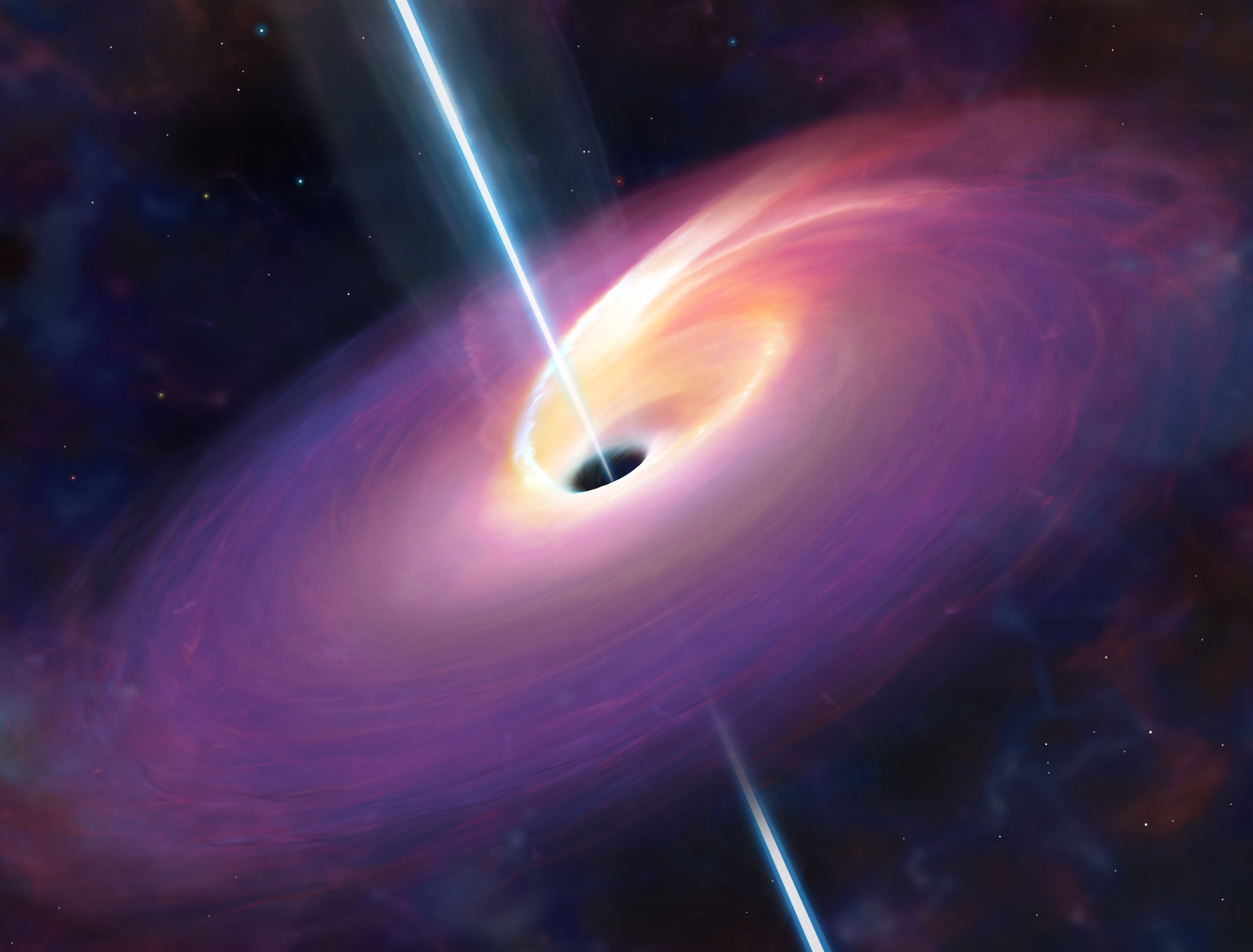
A black hole 3.8 billion light-years from Earth is shown in this artist's representation tearing apart a star that drifted within its gravitational pull. This scenario is part of a new explanation for one of the brightest events ever recorded by astronomers. After consuming the star the black hole released a high-energy beam of gamma rays and x-rays, according to Joshua Bloom of the University of California, Berkeley, and his associates. The research, based on data collected by NASA's orbiting Swift Gamma-Ray Burst observatory, is published in the June 16 issue of Science. In the same issue, Andrew Levan of the University of Warwick and his colleagues pinpoint the beam's source as a black hole at the center of a distant galaxy.
  Caught in the Act: A Black Hole Scuttles a Star


The signal that the Swift satellite received lasted longer than any previously detected gamma ray burst. Rather than declining in intensity after a few minutes as is typical, the brightness of the gamma rays continued to fluctuate and spike over the course of two days. Meanwhile, the x-ray flare's afterglow remained bright for more than two weeks.

The beam's longevity and intensity suggest that a massive black hole, more than a million times heavier than the sun, released two concentrated jets of energy after pulling a star apart. One of the beams pointed directly toward Earth whereas the other traveled off in the opposite direction. The beam's intensity fluctuated as the black hole sucked in leftover pieces of the doomed star.

—Sophie Bushwick

More info: http://www.scientificamerican.com/gallery_directory.cfm?photo_id=9A1A4E79-C6CE-14F2-A959C153FF0FA7C3&WT.mc_id=SA_CAT_BS_20110617